
Officer Development Plan Builder
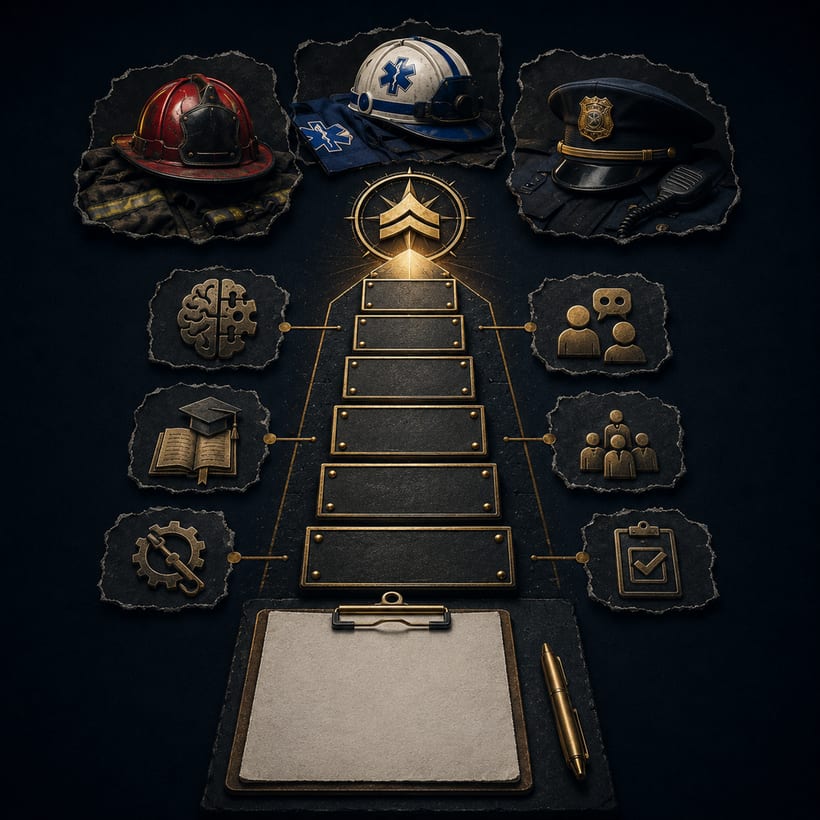
A 12-month development plan moving a firefighter/EMT toward company officer, with competency priorities, courses, assignments, mentoring topics and milestones.
This is a fictional sample report. Main Street Fire Department and Main Street Police Department are illustrative examples and do not represent any real agency. Figures, names and details are invented to show what this tool produces.
Here is a starting plan. Adapt the courses and assignments to what your department actually offers, and set real dates with the candidate and their mentor.
Development objective
Over the next 12 months, Candidate will develop the knowledge, skills and judgment required to transition from firefighter/EMT to fire-service company officer. This plan prepares Candidate to complete the department's company officer certification track, demonstrate mastery of leadership, incident command, communication, decision-making, mentoring and administrative competencies, and successfully serve in an acting-officer capacity for at least six months before consideration for permanent promotion.
Competency priorities
- Leadership and supervision: Building authority and credibility with peers, managing personnel performance, creating a positive crew culture, and holding team members accountable.
- Incident command and scene management: Understanding command structure, establishing and maintaining scene safety, delegating assignments, and making sound decisions under pressure.
- Communication: Delivering clear orders and feedback, listening actively, adapting messages to diverse audiences, and ensuring critical information reaches all stakeholders.
- Decision-making: Gathering information quickly, weighing competing priorities, applying department policy and best practices, and committing to decisions while remaining open to new input.
- Mentoring and training others: Assessing crew knowledge and skills, coaching individuals, delivering feedback that builds capability, and creating learning opportunities during routine and emergency operations.
- Administration and documentation: Completing incident reports and personnel records accurately, managing crew scheduling and resource allocation, and maintaining compliance with department procedures.
Courses & reading
- Company officer certification track: Candidate must complete all required courses within the department's official company officer certification program. This typically includes courses in fire-service leadership, company-level incident command, personnel management, and fire/EMS operations.
- Supplemental leadership and management courses: External or department-offered training in first-line supervision, team dynamics, conflict resolution, and performance coaching.
- Incident command system (ICS) training: Formal coursework in ICS principles at the company officer level, including multi-agency coordination and large-incident management.
- Fire/EMS operations and tactics: Advanced training in crew assignments, scene priorities, resource deployment, and decision protocols specific to fire suppression, rescue and emergency medical response.
- Administration and documentation: Training in report writing, record-keeping systems, personnel evaluation methods and compliance documentation.
- Mentoring and coaching: Courses or modules on adult learning, feedback delivery, and coaching techniques for developing crew members.
- Reading and self-study: Curated reading list on fire-service leadership, incident command case studies, personnel management, and fire/EMS operations. Candidate should review department policies, procedures manuals, and standard operating guidelines relevant to company officer duties.
Practical assignments
- Acting-officer rotations: Candidate will serve in an acting-officer capacity for a minimum of six months, with increasing frequency and complexity of assignments. These rotations should span different shift types, staffing levels, and operational scenarios.
- Incident command shadowing: Candidate will observe and assist experienced company officers during emergency incidents, focusing on command decisions, crew coordination, resource management, and scene priorities.
- Crew training delivery: Candidate will plan, organize and deliver training sessions to peers on topics aligned with department standards, such as equipment use, safety procedures, and operational drills.
- Projects and committees: Candidate will lead or participate in department projects such as standard operating procedure review, equipment testing, crew scheduling, or safety audits. These experiences build administrative competency and cross-functional communication.
- Mentoring assignment: Candidate will be assigned one or more crew members to mentor, with the goal of developing specific skills or preparing them for advancement. This assignment builds Candidate's coaching skills and understanding of individual development.
- Performance evaluation participation: Candidate will assist senior officers in conducting crew performance evaluations and feedback sessions to learn assessment methods and documentation standards.
Mentoring topics
- Leadership presence and credibility: Discuss strategies for earning respect and trust from peers transitioning to a supervisory relationship, managing former peer dynamics, and establishing clear expectations.
- Decision-making frameworks: Review real and hypothetical incidents to analyze how company officers gather information, assess risk, make timely decisions, and communicate those decisions to the crew and command.
- Personnel management and accountability: Explore techniques for performance coaching, handling difficult conversations, addressing compliance issues, documenting problems, and supporting crew development.
- Incident command and scene priorities: Debrief emergency calls to examine command decisions, crew assignments, resource allocation, and how the officer prioritized safety, operations and communication.
- Communication and delegation: Practice delivering clear orders, clarifying expectations, listening to crew input, asking clarifying questions, and adapting communication style for different situations and audiences.
- Mentoring and coaching others: Discuss Candidate's experience mentoring peers, challenges in feedback delivery, and strategies for creating a learning culture on the crew.
- Administration and documentation: Review crew schedules, incident reports, personnel records and standard operating procedures to build familiarity with systems and expectations.
- Stress management and crew welfare: Discuss managing the transition to officer, handling stress, supporting crew mental and physical health, and maintaining work-life balance.
Milestones
- Month 1-2: Candidate completes orientation to company officer role; enrolls in department's company officer certification track; identifies mentor and establishes regular check-in schedule; begins reading core department policies and leadership materials.
- Month 2-3: Candidate completes first modules of certification track (e.g., fire-service leadership fundamentals, ICS training); shadows company officers on at least [number] of emergency incidents; delivers first crew training session under supervision.
- Month 3-4: Candidate completes additional certification coursework (e.g., personnel management, crew operations); begins first acting-officer rotation with mentor support; leads mentoring sessions with assigned crew member.
- Month 4-6: Candidate completes company officer certification track; completes at least one full acting-officer rotation (minimum [duration] shifts); participates in department project or committee; mid-plan review with mentor and leadership.
- Month 6-8: Candidate continues acting-officer rotations with increasing independence; leads additional crew training or drill sessions; completes supplemental leadership or operations coursework; participates in incident debrief sessions.
- Month 8-10: Candidate completes final acting-officer rotations; demonstrates competency in decision-making, crew supervision and administrative duties; completes mentoring cycle with assigned crew member; finishes required reading and self-study.
- Month 10-12: Candidate completes full six-month acting-officer service requirement; final check-in and evaluation with mentor and supervising officer; readiness assessment for permanent promotion consideration; documentation of competency achievement across all six areas.
Check-in questions & completion indicators
- Is Candidate demonstrating leadership presence and earning respect from crew members in acting-officer roles?
- Can Candidate articulate a clear decision-making process for common incident types and crew management situations?
- Is Candidate delivering clear, timely instructions and adapting communication to different audiences?
- Does Candidate complete incident reports, personnel documentation, and administrative tasks accurately and on time?
- Is Candidate effectively coaching and mentoring assigned crew members, with evidence of improved performance or skill?
- Has Candidate completed all modules of the department's company officer certification track?
- Can Candidate demonstrate incident command principles in real or simulated scenarios, including scene safety, crew deployment, and resource management?
- Is Candidate meeting attendance and performance expectations during acting-officer rotations?
How this was made. This report pairs a structured public-safety framework with AI drafting to give you a strong, fast starting point. Treat it as informed guidance, not a final answer, and confirm the specifics against your department’s own facts and judgment before you act.