Making Sure Your Message Actually Landed

I have sat in enough after-action conversations to know the exact sentence that comes up every time something important got missed. "I sent it." Said with real confidence, usually followed by someone pulling up the email or the text to prove it went out.
Sending a message is not the same as it being received. Receiving it is not the same as reading it. And reading it is not the same as understanding it. Three separate things have to happen for a communication to actually work, and most departments only ever verify the first one.
That gap between sent and understood is where policy changes get missed, where schedule changes cause people to show up at the wrong time, and where safety notices sit unread until after something goes wrong. The department did its job by sending the message. The information still did not land.
Why "I Sent It" Is Not Good Enough
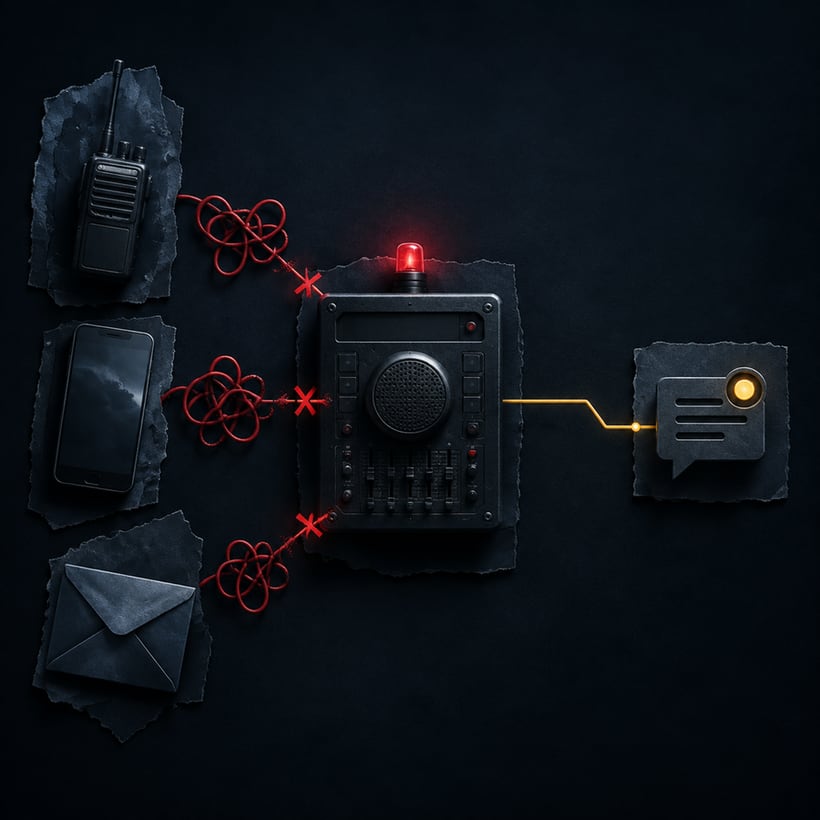
Treating delivery as proof of communication is an easy trap, because delivery is the part you can actually verify. You know the email left your outbox. You know the text was sent. What you do not know, unless you build a way to check, is whether it arrived somewhere the person actually looks, whether they opened it, and whether they understood it the way you intended.
Every one of those steps can fail quietly. An email can land in a folder nobody checks. A text can get read at a glance and misremembered an hour later. A notice posted on a board can be seen by someone in a hurry who registers that something changed without registering what. None of those failures show up as an error. Nothing bounces. Nothing gets flagged. The message simply does not do what it was sent to do, and unless you go looking, you will never know.
This matters most for exactly the messages departments are least likely to double check: policy changes, schedule changes and safety notices. These are the messages where "I sent it" feels the most reassuring and is the most dangerous to rely on, because the cost of a member not actually understanding one of them is not a mild inconvenience. It is a missed shift, a procedural violation, or someone operating without information that affects their safety.
Acknowledgment Is Not Bureaucracy, It Is a Signal
Some agencies resist requiring acknowledgment because it feels like extra process for its own sake. I understand the instinct. Nobody wants to turn every notice into a form to sign. But acknowledgment, done right, is not paperwork. It is the only reliable signal you have that a message actually reached someone.
Reserve it for what actually needs it. A reminder about a social event does not need a confirmed read receipt. A change to a safety procedure does. A new duty schedule does. The line is not complicated: if getting it wrong could put someone in the wrong place, out of compliance, or at risk, that message needs a way to confirm it landed. Everything else can travel more casually.
Acknowledgment can be simple. A member confirming they viewed a notice, a signature on a schedule change, a short response required for a safety update. The mechanism matters less than the discipline of having one at all for the category of message where being wrong is expensive.
Read-Back Catches What Acknowledgment Misses
Acknowledgment tells you a message was seen. It does not tell you it was understood correctly, and those are different failures with different fixes.
A read-back, having the person state the information back in their own words, catches the second kind of failure. It is a habit borrowed from radio communication for a good reason: it works. Someone can confirm they saw a schedule change and still have the wrong date in their head. A quick read-back, even an informal one where an officer asks a member to repeat what changed, surfaces that kind of misunderstanding immediately, while it is still cheap to correct, instead of on the day the member shows up at the wrong time.
This does not need to be a formal process for every piece of information. It is most valuable exactly where the stakes are highest: a procedural change taking effect immediately, a safety notice with specific actions attached, anything where a slightly wrong understanding is genuinely dangerous rather than mildly inconvenient.
Build the Habit of Closing the Loop
The underlying shift here is not a new tool. It is a habit. Stop treating a sent message as a finished task, and start treating it as an open one until you have some evidence it landed correctly.
That habit shows up in small ways. An officer who follows up a written notice with a direct question at the next briefing, rather than assuming the notice covered it. A supervisor who checks in with a member who was off when a safety change went out, rather than assuming they caught it later. A department that reviews, after a missed schedule change or a procedural mistake, not just what happened but whether the original message had any way of confirming it was understood in the first place.
None of this requires new technology, though the right tools make it easier to track who has and has not confirmed something. What it requires is deciding, as a matter of policy, that certain categories of information are not considered communicated until there is evidence someone received and understood them, and building the follow-up into the process instead of hoping it happens informally.
Assume Nothing Landed Until You Know It Did
The comfortable version of internal communications treats sending as the finish line. The honest version treats sending as the starting point, and treats delivery, comprehension and confirmation as three separate things that all have to happen before you can call something communicated.
That is a higher bar, and it should be. Policy changes, schedule changes and safety notices are exactly the messages where "I sent it" feels like enough and is the least trustworthy claim in the building. Build the habit of closing the loop, and you stop finding out the hard way, after a missed shift or a procedural mistake, that sending was never the same thing as landing.
Tools for this topic
Free interactive tools to put this into practice.
 AssessmentInternal Communications Health Check
 BuilderDashboard Content Planner
 BuilderCommunication Channel Mapper
 Part of the seriesInternal CommunicationsExplore the series
 Recent posts
All posts →